"What's your net worth?" is one of those questions that sounds simple but answers almost nothing on its own. A net worth of $150,000 might mean you're comfortably ahead of the curve, or meaningfully behind — and the number alone can't tell you which. What actually gives it meaning is context: your age, your income, and how those compare to people in a similar position. That's relative net worth, and it's a far more useful way to answer "how am I actually doing?"
Net Worth, Quickly
Net worth is simple to define: everything you own, minus everything you owe. Add up your cash, investments, retirement accounts, home equity, and other assets. Subtract your mortgage, credit card balances, student loans, and other debts. What's left is your net worth — a single number that can be negative, small, or substantial, depending entirely on where you are in your financial life.
That last part is the whole problem with looking at the number in isolation. A 24-year-old two years out of school and a 55-year-old with three decades of career earnings behind them are going to land in very different places, and that gap says nothing by itself about who is doing better relative to their own circumstances.
Why the National Average Is the Wrong Comparison
It's tempting to Google "average net worth" and measure yourself against whatever number comes back. This is usually the wrong move, for a specific, well-documented reason: the average and the median tell very different stories, and most people should be looking at the median.
According to the Federal Reserve's Survey of Consumer Finances — the most comprehensive source of household wealth data in the U.S. — the average net worth across all households is roughly $1.06 million, while the median is roughly $192,900. That's not a typo or a rounding issue; it's a five-times gap, driven entirely by a relatively small number of extremely wealthy households pulling the average upward. The median — the household exactly in the middle of the distribution — is the far more honest benchmark for where a typical household actually stands.
And even the median, on its own, mixes together 25-year-olds and 70-year-olds into one number. That's why age-adjusted context matters more than either figure alone.
Median Net Worth by Age
Here's how median household net worth breaks down by age, based on the Federal Reserve's 2022 Survey of Consumer Finances (the most recent published data available, with the next survey's results expected in late 2026):
| Age Range | Median Net Worth |
|---|---|
| Under 35 | ~$39,000 |
| 35–44 | ~$135,600 |
| 45–54 | ~$247,200 |
| 55–64 | ~$364,500 |
| 65–74 | ~$409,900 |
| 75+ | ~$335,600 |
Source: Federal Reserve Board, Survey of Consumer Finances (2022 data, most recent available).
A few things worth noticing here. Net worth climbs steadily through the working years, peaks around ages 65–74, then declines — largely because retirees are drawing down savings rather than adding to them. And the jump from the under-35 bracket to the 65–74 bracket is more than tenfold, which is exactly why comparing a 28-year-old to "the average American" produces a number that mostly reflects decades of head start, not decades of better decisions.
Age Is Only Half the Picture — Income Is the Other Half
Two people the same age can have wildly different realistic net worth targets depending on what they earn. Someone earning $50,000 a year and someone earning $200,000 a year are working with very different capacity to save and invest, even if they're equally disciplined. A meaningful comparison has to account for both dimensions at once — age and income — not just one.
This is the actual definition of relative net worth: not "how do I compare to everyone," but "how do I compare to people who look like me on the dimensions that actually predict where someone should reasonably be."
How Watni Shows This
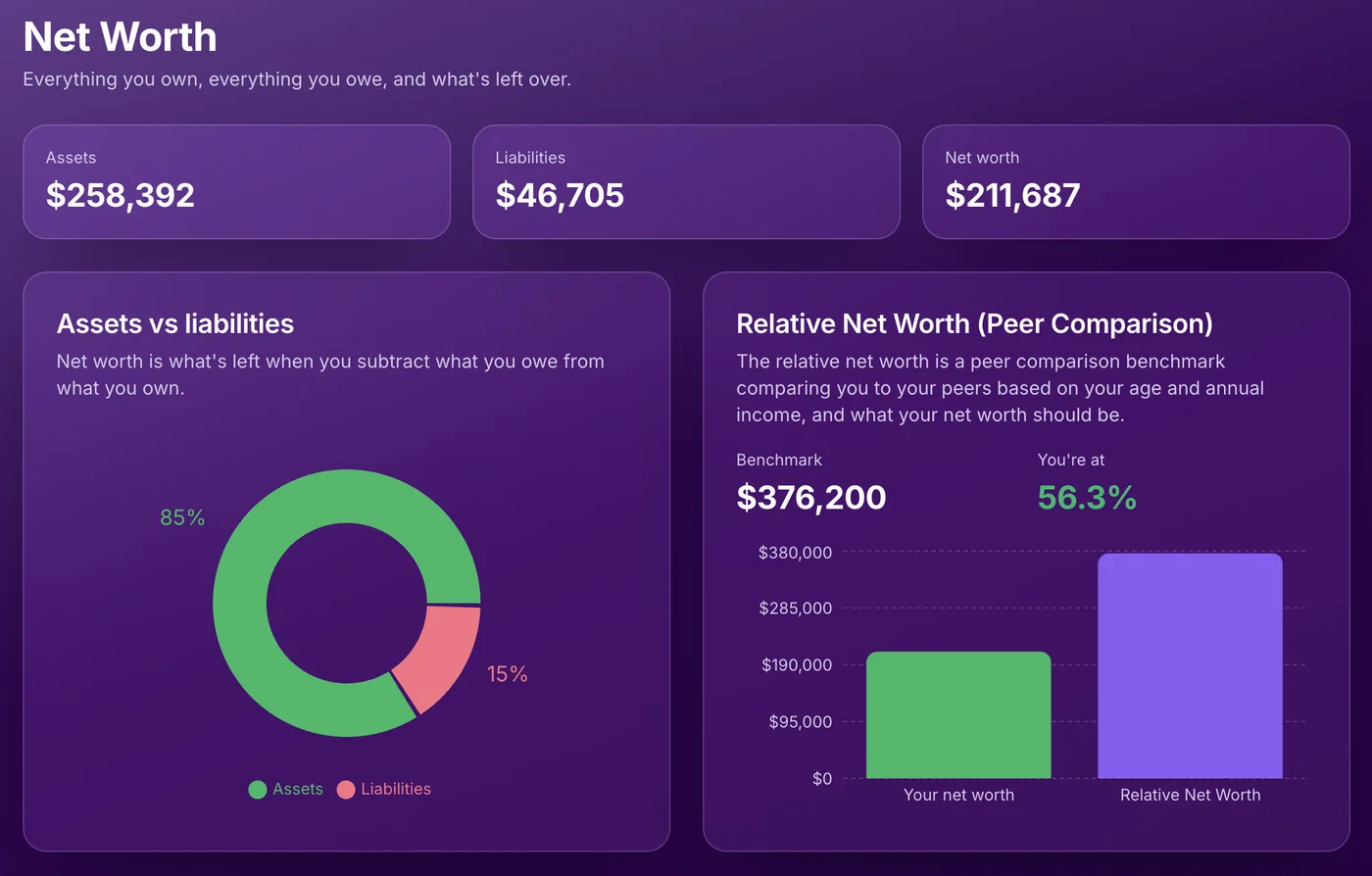
This is exactly what Watni's Net Worth screen is built to answer. Alongside your raw assets, liabilities, and net worth, it shows a relative net worth benchmark — a peer comparison based specifically on your age and income, not a flat national number. Here's a simplified look at how that shows up in the app:
In this example, the benchmark is what someone at the same age and income level would typically have, and the percentage shows where the user currently stands against that specific target — not against the country as a whole, and not against a peak-earning 65-year-old when they're 30. That's the difference between a number that's technically accurate and a number that's actually useful.
What To Actually Do With This
- Use the median, not the average, as your starting reference point — it isn't distorted by a small number of very wealthy households.
- Compare within your age bracket, not against the full population, since net worth naturally compounds over decades.
- Factor in income, since two people the same age with different earning power have different realistic targets.
- Treat any benchmark as a reference point, not a verdict — a number below the median isn't a personal failure, and one above it isn't permission to stop paying attention.
The Bottom Line
Net worth by itself is just a snapshot. Relative net worth — net worth in the context of your age and income — is what turns that snapshot into something you can actually act on. It's the difference between "is $150,000 good?" and "is $150,000 good for a 32-year-old earning $85,000 a year?" Only one of those questions has an answer worth paying attention to.